Measure the reach that matters.
Reach is a rate, not a pile of likes.
A like count rewards the account that already had the biggest audience and tells a smaller one nothing it can act on. Bloom instead divides the reach a post earned by the audience that could have seen it, which turns reach into a percentage that means the same thing on every account. A post that reached 46% of a 312-follower account is genuinely outperforming one that reached 9% of a 51,000-follower channel — and on a raw count the second would look like the winner purely because the account is bigger.
The same scale for every account
Because the denominator is the addressable audience, a brand running one niche account and one flagship channel can read both on one chart without the flagship drowning the niche. The rate is what you optimise; the raw number is what you report to someone who wants a big figure. Bloom keeps both, and leads with the one you can learn from.
Reach, then the click
Reach by rate tells you a post was seen in proportion to who could see it. It does not, on its own, tell you anyone acted. That is why reach and attribution live side by side here — the rate shows the post worked as content, the tracked shortlink shows it worked as a path to your site, and the two disagree often enough to be worth watching.
Nothing invented to fill the gap
Where a network returns no reach figure, Bloom does not estimate one from followers or impressions on another platform. An estimate stitched across networks reads as a real measurement and is not one. The brand median above is computed only over the accounts that actually reported, and it says so.
Every post read four times as it ages.
Engagement arrives over days, not in the first minute, so a single reading taken whenever you happen to open the dashboard compares posts measured at different ages and quietly lies. Bloom re-reads each post at four fixed ages — 1 hour, 6 hours, 24 hours and 72 hours after it went out through the publishing queue— on the networks that report engagement. Measuring at the same ages every time is what makes a Tuesday post and a Friday post genuinely comparable.
Why four, and why those four
One hour catches the early spike a feed algorithm rewards, six hours catches the working-day tail, twenty-four hours catches a full daily cycle across time zones, and seventy-two hours catches the long tail before a post is effectively dead. Four reads describe the whole curve without storing a reading every minute for a number that barely moves after the third day.
Comparable by construction
Because the ages are fixed, “best post this month” means best at the same point in its life as every other post, not best as caught at a convenient moment. The comparison is honest even when the posting schedule is not evenly spaced.
See which post actually drove the click.
Reach answers “was it seen?” Attribution answers “did it send anyone anywhere?” Every Bloom post can carry a UTM tracked shortlink, so a click is resolved back to the exact post, the network it was posted on and the hook that opened it. That is the difference between knowing a campaign was visible and knowing which line of it earned the visit.
Post, network and hook
The same announcement posted five ways rarely performs five ways. Attribution splits the clicks by where they came from, so the hook that worked on one network and flopped on another is visible as two different lines rather than one blended average that hides both.
It works wherever a link can go
A tracked shortlink rides on any post that carries a link, so attribution is not limited to the ten networks that report engagement. A network can be silent on reach and still send measurable clicks, and the shortlink captures those even where the platform’s own analytics return nothing.
Answers land back with you
When a post prompts a reply, that conversation arrives in Bloom’s unified inbox on the networks that return messages, so the click you measured and the reply it produced are not in two different tools. Reach, click and reply are three stages of one path.
Measured only where the network returns it.
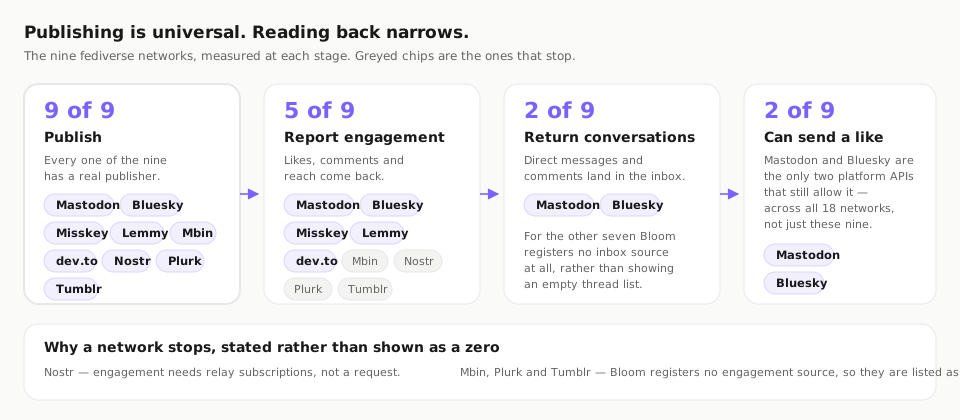
A dashboard that invents numbers to look complete is worse than one that admits a gap, because you make decisions on it. Bloom reports reach and engagement only on the networks that return the data, and lists the rest as unreported with a reason. Of the eighteen networks on the networks page, every one publishes, ten return engagement Bloom can read, and three return competitor benchmarks.
| What Bloom reads back | Of 18 networks | Notes |
|---|---|---|
| Publishing | 18 of 18 | Every network Bloom supports can post. |
| Engagement and reach | 10 of 18 | Read at 1, 6, 24 and 72 hours, only where the network returns it. |
| Competitor benchmarks | 3 of 18 | Mastodon, Bluesky and YouTube — the three that return them. |
| Click attribution | Yes | A UTM tracked shortlink on any post that carries a link. |
Benchmarks only where a platform hands them over.
Competitor numbers are the most over-claimed figures in social analytics, because most platforms do not expose them and a tool can only show them by guessing. Bloom shows a benchmark only on the three networks that genuinely return competitor data — Mastodon, Bluesky and YouTube — and declines to manufacture one anywhere else.
Where a benchmark exists, it compares your rate against what that platform reports for comparable accounts — a rate against a rate, never your small account against a giant’s raw totals. Where no benchmark exists, Bloom says so on the network rather than filling the space with a figure assembled from somewhere it does not apply. A fabricated benchmark is the kind of number that survives exactly until the one meeting where someone checks it, and Bloom is built not to ship it in the first place.
Analytics questions, answered plainly.
How does Bloom measure reach?
Why does Bloom read every post four times?
Which networks does Bloom report engagement and reach for?
Can Bloom show which post actually drove a click?
Does Bloom benchmark me against competitors?
What does Bloom show when a network returns no analytics?
Read the rate, not the raw count.
Bloom runs on its own application and its own sign-in — an Autocloz account is not required. Connect your accounts, publish from a per-brand queue, and watch reach come back by rate at four fixed ages, reported only where it is real.